
Feminism Isn’t Just One Thing: The First Wave Explained


Understanding the different waves of feminism matters because feminism is not a single idea, strategy, or moral position; it is a long-running argument about power, inclusion, and what real change entails.
Each wave emerged in response to the limits and failures of the one before it, carrying forward both hard-won progress and unresolved harm. Without this context, today’s feminist debates can appear as personality clashes or generational infighting, when they are, in fact, deeply rooted political tensions: access versus transformation, protection versus autonomy, representation versus redistribution.
The wave framework itself is imperfect, Western, and incomplete - but it remains a useful map.
Not because it tells us where feminism is going, but because it shows us where it has been, what it keeps getting wrong, and why this conversation is still unfinished.

Feminism Didn’t Appear Out of Thin Air
Feminism did not pop up overnight - despite what some TED Talks and Instagram timelines might suggest. Women have been fighting for autonomy, dignity, safety, and power for as long as systems have existed to deny them those things.
Across cultures and centuries, women resisted in whatever ways they could: through labor, mutual aid, caregiving networks, religious dissent, underground economies, lawsuits, strikes, storytelling, rebellion, and survival itself. Sometimes those efforts resulted in real gains. Often, they were punished, erased, or quietly absorbed into the systems they challenged.
What is relatively new is not women’s resistance, but the formal naming, organization, and professionalization of that resistance as feminism.
The Birth of the First Wave
The term feminism entered the political landscape in the late nineteenth and early twentieth centuries, as these long-standing struggles began to cohere into identifiable movements - particularly in Europe and the United States. Historians refer to this period as first-wave feminism, a label that is tidy in theory and messy in reality. It reflects a movement shaped by its time, its geography, and its proximity to power.
First-wave feminism was not a comprehensive liberation project. It was a targeted response to a specific set of legal and political barriers facing certain women - and it succeeded and failed accordingly.
What Tripped the Trigger
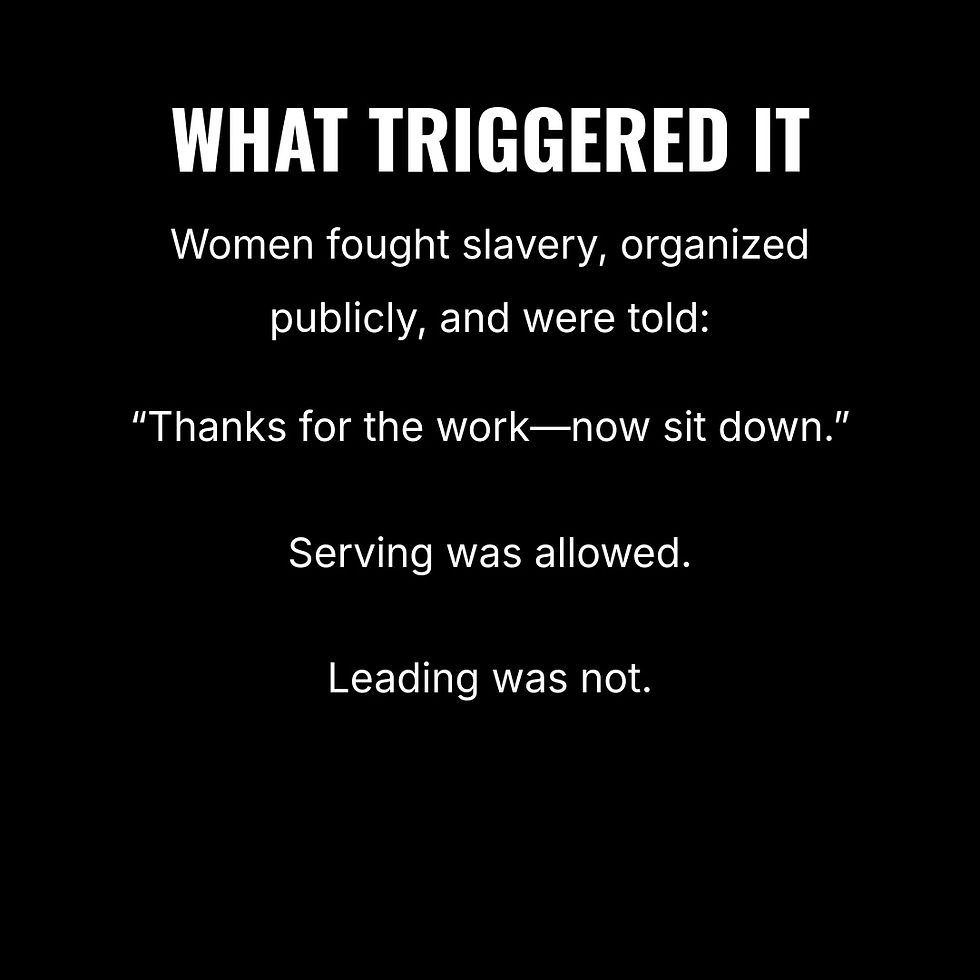
First-wave feminism did not emerge because society suddenly became enlightened about women’s rights. It emerged because women were already doing the work of public life and were repeatedly told to sit down, stay quiet, and accept their subordinate status while doing it.
In the United States and much of Europe, the immediate spark came through women’s involvement in the abolitionist movement. Women organized petitions, raised funds, ran meetings, and spoke publicly against slavery - only to discover that their political usefulness did not translate into political standing. They were welcome to serve but not to lead, to advocate but not to vote, to fight for freedom but not to claim it for themselves.
That contradiction became impossible to ignore in 1840, when women abolitionists were barred from full participation as delegates at an international anti-slavery convention. The message was unmistakable: thank you for your labor - now know your place. From that exclusion arose a growing realization that women could not secure justice for anyone, including themselves, without legal recognition as independent persons. When this collided with rapid industrialization, urbanization, and women’s increasing participation in wage labor under laws that still treated them as legal dependents, the tension became unsustainable.
First-wave feminism was triggered by a destabilizing truth: women were essential to public life, but invisible under the law.
Who Led the Movement - and Who Didn’t
First-wave feminism was led primarily by white, middle- and upper-class women - yes, wealthy ones. Educated ones. Women with social standing, leisure time, and access to political networks through churches, reform societies, and family ties to power. This was not incidental. Organizing nationally required money, literacy, mobility, and respectability. The women most able to claim those resources were already closest to institutional power, and so they became the movement’s public face and dominant voice.
At the same time, Black women, Indigenous women, working-class women, immigrant women, and formerly enslaved women were organizing, resisting, and theorizing liberation - often in more dangerous and materially risky ways. Yet they were routinely sidelined, tokenized, or excluded from leadership within mainstream suffrage organizations. When racial justice complicated political strategy or threatened alliances with white male power, many white suffrage leaders chose expediency over solidarity.
This tension became explicit after the Civil War, when some white feminists opposed Black men gaining the right to vote before white women and made openly racist claims about who was “fit” for citizenship. Equality, for much of the movement, had boundaries - and those boundaries were racial and class-based.
What First-Wave Feminism Actually Solved
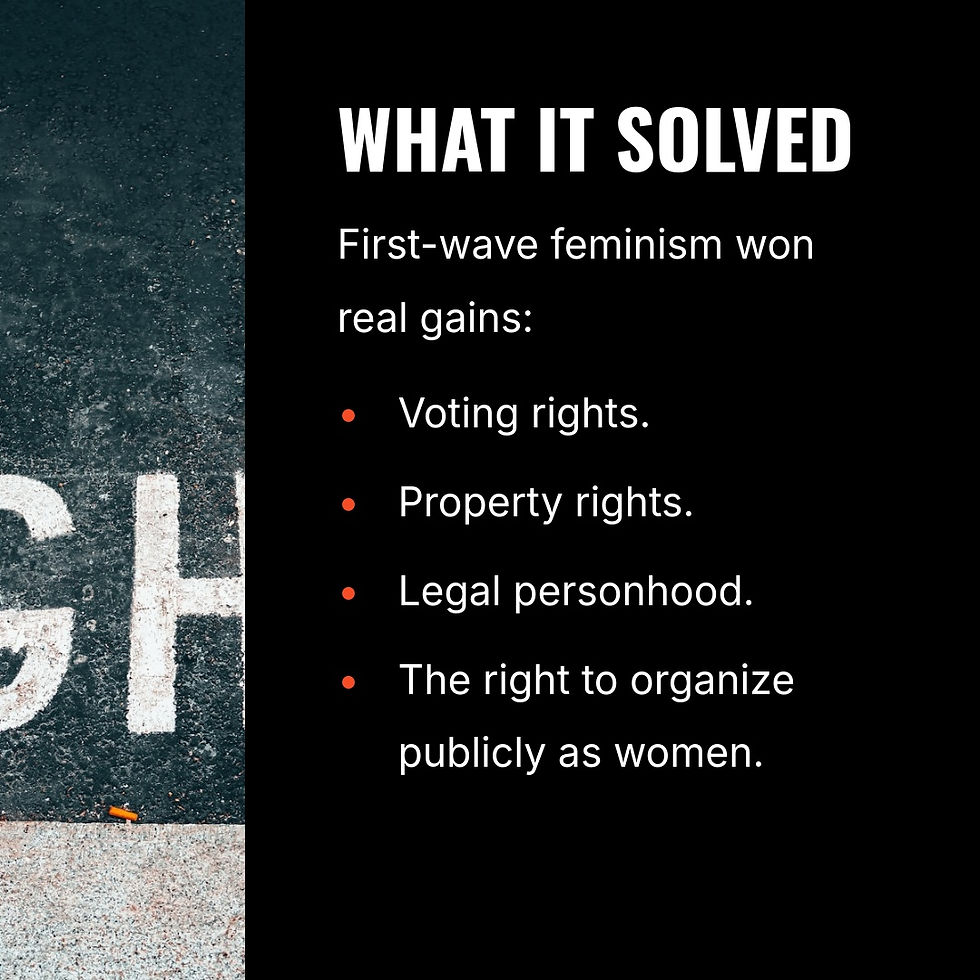
Despite these limitations, first-wave feminism achieved real and lasting victories. It fundamentally altered women’s legal status by challenging doctrines such as coverture, which rendered married women legally invisible. It secured property rights, expanded custody rights, opened access to education and professions, and - most famously - won women the right to vote in many countries.
These were not symbolic wins. Legal personhood mattered. Citizenship mattered. The ability to own property, sign contracts, and participate formally in political life reshaped women’s relationship to the state, to work, and to survival.
First-wave feminism also accomplished something subtler but equally important: it normalized the idea that women could organize publicly, collectively, and unapologetically around their own interests. It built infrastructure - organizations, publications, conventions - that future movements would inherit, critique, and transform.

The Problems It Created - and Left Behind
But the movement’s narrow focus was both its strength and its weakness. By centering legal access to citizenship rather than interrogating how citizenship itself was structured, first-wave feminism accepted the basic architecture of power rather than challenging it. It asked who could be included, not whether the system was just.
Labor exploitation, racial violence, colonialism, economic inequality, and state power largely fell outside its frame.
Respectability politics became both a strategy and a constraint. Inclusion was conditional. Liberation was partial.
This choice embedded a tension that has never fully disappeared from feminist politics: is feminism about expanding access to existing power, or about transforming how power operates at its core? First-wave feminism answered that question by choosing access. That choice made progress possible - and baked in exclusions that future generations would be forced to confront.
Progress? Undeniable.Liberation? Incomplete.
And that unresolved tension is exactly what later waves of feminism would inherit, challenge, and struggle to undo.

Fund liberation - not optics.
Your donation supports feminist work rooted in lived experience, accountability, and real-world impact - not polished talking points.
Donate to SWOP Behind Bars today at www.swopbehindbars.org


