
Not Your Mama’s Feminism: Sex Workers Have Always Been Here

Updated: Mar 2

The Convenient Fiction of Absence
There is a persistent fiction at the heart of modern feminist policy debates: the idea that sex workers are a new complication, an inconvenient edge case, or a group that can be spoken about rather than listened to.
As if we arrived late to the conversation.
As if we are an add-on, not a foundation.
This framing makes it easier to design policy without us-and easier still to ignore the harm that follows.

The truth is far less comfortable for mainstream feminism.
Sex workers have been part of feminist movements from the beginning. We have organized, theorized, provided care, funded mutual aid, built safety networks, resisted police violence, and articulated critiques of state power long before those ideas were safe, fundable, or hashtag-ready. What changes across feminist eras is not our presence, but whether feminism chooses to see us.

Exclusion Isn’t Neutral - It Warps the Analysis
When sex workers are excluded from feminist analysis, the gaps are immediate and obvious.
Policy conversations become abstract.
Harm becomes theoretical.
Safety is framed as something administered to people rather than built with them.
Criminalization slides in under the language of care because no one in the room is naming its costs from lived experience.
This is how feminism ends up endorsing systems that treat arrest as intervention, confuse surveillance with protection, accept family separation and incarceration as “unfortunate but necessary,” and measure success by compliance instead of autonomy.
Without sex workers at the table, feminism loses the ability to recognize when “help” is actually coercion, and stops asking who pays the price.

Erasure Always Hits the Margins First
Excluding sex workers does not just silence one group; it distorts outcomes for everyone feminism claims to care about. Policies built without us land hardest on Black and Indigenous women, migrants, trans people, disabled people, poor and working-class women, and survivors navigating complex survival strategies.

In our absence...
feminist policy defaults to police-led solutions, court-mandated “services,” and nonprofit intermediaries tasked with translating lived experience into fundable soundbites. Outcomes are tracked through arrest numbers, referrals, and enrollments, while the real costs-lost housing, lost custody, accumulated debt, deportation risk, workplace blacklisting, and the slow erosion of trust-remain conveniently uncounted.
Sex Workers Have Been Doing Feminist Work All Along
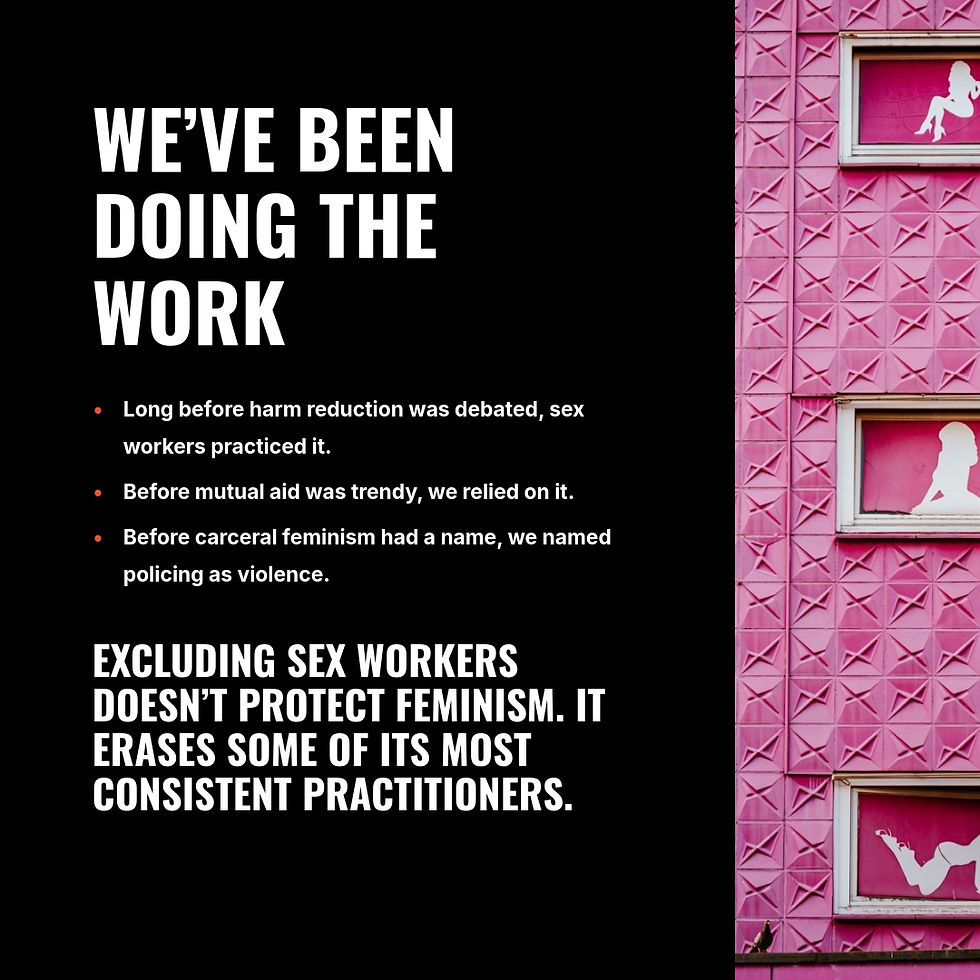
Long before mainstream feminism debated harm reduction, sex workers were practicing it.
Long before “mutual aid” became fashionable, sex workers were running informal safety nets.
Long before academia caught up to critiques of carceral feminism, sex workers were naming policing as gendered violence.
We have built peer-led safety strategies, shared information to prevent harm, supported one another through incarceration and reentry, fought for bodily autonomy in its most literal sense, and challenged moral hierarchies about whose labor deserves protection.
Excluding sex workers does not protect feminism’s integrity-it erases some of its most consistent practitioners.

The Paternalism Disguised as Protection
One of the most common justifications for exclusion is the claim that sex workers are too compromised, too coerced, or too harmed to speak for ourselves. This argument wears the language of compassion while exercising control.
Feminism would never accept the idea that survivors of domestic violence, incarcerated women, or undocumented workers should be spoken for instead of listened to. Yet when the subject is sex work, that standard quietly disappears.
Speaking about sex workers without including us is not protection. It is power without accountability.

Why Feminism Gets It Wrong Without Us
A feminism that excludes sex workers will always misread reality. It will overestimate the benefits of criminalization, underestimate the harm of state intervention, misidentify exploitation, miss opportunities for real accountability, and reproduce the very hierarchies it claims to oppose. This is not a failure of intention. It is a failure of listening.
What Real Inclusion Demands
Including sex workers is not symbolic; it is structural. It requires treating lived experience as expertise, not anecdote. It means allowing sex workers to lead policy conversations about our own lives, rejecting models that require arrest as proof of care, and funding peer-led, non-carceral solutions. It also requires accepting a hard truth: autonomy and safety are not opposites, and some feminist “wins” have come at our expense.

The Reckoning Feminism Keeps Postponing
Sex workers are not a footnote, a moral dilemma, or a problem to be managed. We are organizers, caregivers, workers, survivors, thinkers, and leaders. We have always been here.
A feminism that excludes sex workers is not protecting women-it is narrowing the definition of who counts. And a feminism that narrows its vision will always mistake punishment for progress.
Feminism can do better-but only if it stops pretending we arrived late and starts acknowledging who has been holding the line all along.


