
The Nordic Childcare Model: Essential Work Everyone Depends On

Childcare is some of the most common and necessary labor in modern life.
Millions of parents rely on babysitters, nannies, and childcare workers every day so they can go to work, attend school, run errands, or simply get a few hours of rest.
The work is deeply personal. It involves feeding children, supervising them, helping with homework, managing routines, and keeping them safe.
It is also physically demanding, emotionally intensive, and full of real responsibility.

Like many service jobs, childcare often exists in both formal and informal labor markets. Babysitters may work independently, pick up short-term gigs, or move between households. Teenagers, college students, neighbors, career nannies, and professional caregivers all participate in this workforce. Some find jobs through agencies, daycare centers, or apps. Others rely on word of mouth and private referrals. However it is arranged, the work is widespread, flexible, and essential.

Reframing Childcare as a Social Problem
Now imagine policymakers deciding that babysitting itself is a social problem.
Reports begin circulating about the risks involved in childcare work. Babysitters are responsible for children’s safety. They may face liability if something goes wrong. Many enter the field because they need flexible income, have limited options, or cannot access more stable employment. Some families rely on babysitters precisely because formal childcare is too expensive or unavailable.
From there, the argument starts to shift. Critics claim that babysitting is inherently exploitative. Workers are taking on emotional labor, physical responsibility, and legal risk, sometimes under economic pressure, while families benefit from the arrangement.
The service is no longer framed as practical help. It becomes a moral issue.
The “Compassionate” Solution
An outright ban on babysitting would be politically ridiculous. Parents depend on it. Children need supervision. Entire parts of the economy function only because someone is available to provide care.
So instead, policymakers introduce what they call a balanced solution.
Babysitting itself will remain legal. The babysitter is not the criminal. The law will simply target the people who create demand for the service.
Sound familiar?
How the Nordic Childcare Model Works
Under this system, the babysitter has technically done nothing wrong. The law instead focuses on everyone around them.
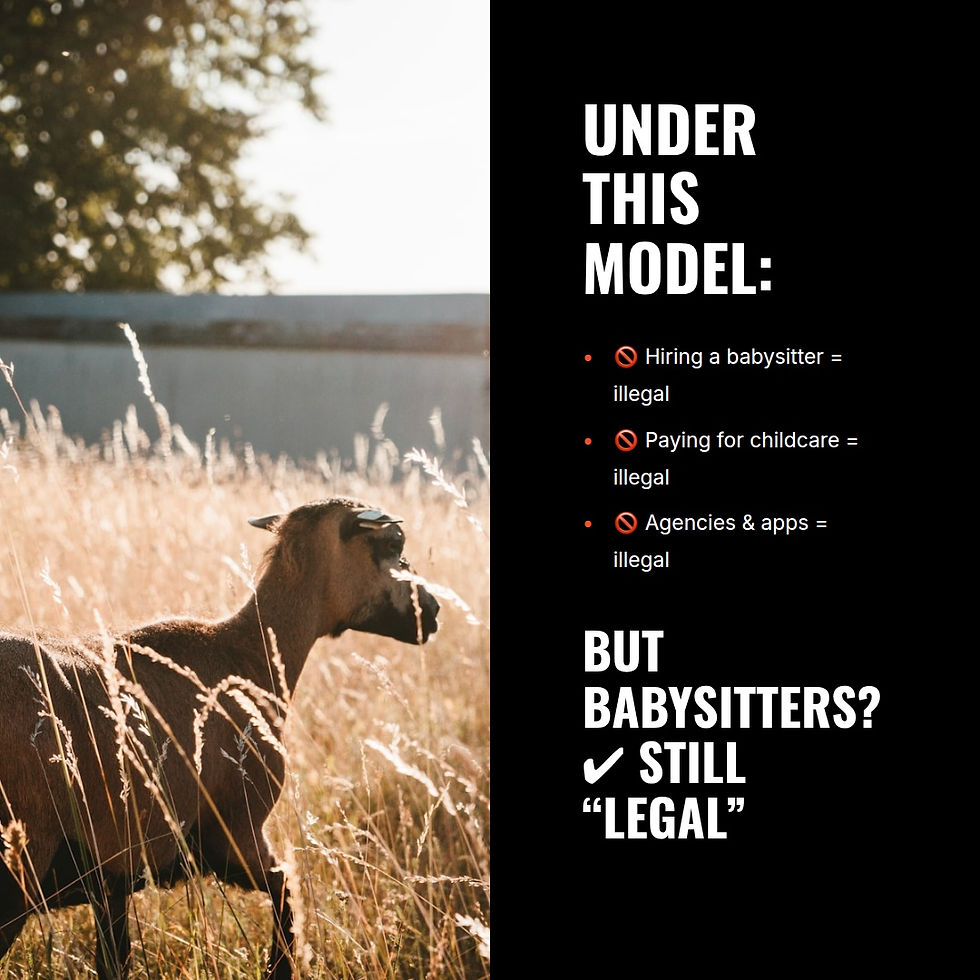
Hiring a babysitter becomes illegal. Paying someone to watch your child becomes illegal. Agencies that connect families with caregivers become illegal. Advertising childcare services becomes illegal. Platforms that help people find sitters come under scrutiny for facilitating an unlawful transaction.
The babysitter remains “legal.” They are just no longer allowed to work in any stable, visible, or protected way.
The Theory: End Demand, End the Work
Supporters of this policy would insist that the goal is not to punish babysitters. They would say the real objective is to eliminate the childcare market by targeting demand. If families cannot legally hire babysitters, demand will fall. If demand disappears, the work itself will disappear.
At least on paper.
The Reality: The Work Does Not Disappear
In real life, parents will still need childcare. Work schedules will not magically change. School hours will still fail to match most jobs. Emergencies will still happen. Single parents will still need help. Families without money for full-time daycare will still need affordable, flexible care.
So babysitting will not go away.
It will simply move further underground. Parents will stop openly posting childcare needs. Babysitters will rely more heavily on private referrals. Families will become less willing to discuss arrangements openly because hiring help now carries legal risk.
The demand remains. The work remains. Only the visibility disappears.

Enforcement Theater
To prove the policy is working, law enforcement might begin conducting undercover operations to catch parents hiring babysitters. Officials could hold press conferences announcing the arrest of “buyers” in childcare stings. A drop in public ads or app listings might be presented as evidence that exploitation is being reduced.
Meanwhile, children will still need care.
Parents will still find someone.
Babysitters will still do the work.
The labor does not end. It just becomes harder to see, harder to organize, and harder to make safer.

When the Infrastructure Disappears
That is where the real damage sets in.
In a system where the transaction cannot be openly acknowledged, the infrastructure that makes childcare safer begins to collapse. Agencies that once screened caregivers disappear because facilitation is illegal. Platforms that once helped workers build reviews and reputations disappear because advertising is illegal. Families become more secretive. Workers have fewer ways to verify employers, negotiate pay, establish boundaries, or rely on professional networks.
The very systems that helped make the work safer and more transparent are stripped away in the name of protection.

What This Thought Experiment Reveals
This is the contradiction at the center of demand-criminalization models.
When most jobs involve risk, vulnerability, or unequal bargaining power, the usual policy response is to improve labor conditions. We create standards. We regulate employers. We build systems for oversight, transparency, and safety. We do not usually respond by criminalizing one side of the transaction and pretending the worker has been protected.
But in some industries, lawmakers take a different route. Instead of improving working conditions, they try to eliminate the market itself by criminalizing demand and targeting the surrounding infrastructure.
The result is rarely the disappearance of the work. More often, the work continues under worse conditions: more hidden, less stable, less accountable, and more dangerous for the people doing it.
Children still need care. Parents still need help. Babysitters still work.
They just do so in a system that has made safety harder to access.
At SWOP Behind Bars, we believe people deserve safety, dignity, and rights at work no matter what kind of labor they do. We are a national network led by current and former sex workers providing support, advocacy, and resources to people impacted by criminalization in the sex trade. This series uses thought experiments like babysitting, construction, military service, and lawn care to examine the logic often used to justify sex work criminalization. By applying those same arguments to other forms of labor, we can see more clearly how these policies actually function in practice. History shows that criminalization does not eliminate risk, exploitation, or poverty. It makes people harder to reach, less able to protect themselves, and more vulnerable to harm. The point is not to trivialize other professions. The point is to expose how irrational it is to claim that criminalizing one side of an adult consensual transaction somehow creates safety for the other.


