Intent Is Not a Metric: Why ‘Good’ Policies Still Cause Harm


We’re Not Measuring Intent Anymore - We’re done debating intentions.
This series starts from a different premise: policies don’t get measured by what they meant to do - they get measured by what they actually do in people’s lives.

“We’re trying to help”...is one of the most durable defenses in modern anti-trafficking policy, feminist reform efforts, and law enforcement campaigns.
It shows up in press conferences, grant proposals, and public messaging.
It sounds compassionate. It signals moral clarity.
And it works - because it redirects the conversation away from outcomes and toward intentions.

But as we saw in January’s Follow the Money series, intent often functions less like a guiding principle and more like a shield.
Funding continues to flow, programs expand, and success is declared - not because harm has decreased, but because activity has increased.
Arrests are counted.
Operations are named.
Headlines are written.
And the system sustains itself.
When Branding Replaces Reality
By March, in The Pink Patriarchy, we delved deeper into how this dynamic is reinforced. Feminist language - empowerment, protection, dignity - gets layered onto policies that don’t always deliver those things in practice. The branding matters. It shapes who feels comfortable supporting a policy, who gets invited into the conversation, and whose experiences are treated as credible. But it also creates distance between how a policy is described and how it is lived. When the narrative is curated, the outcomes can be ignored.

The Thought Experiments That Broke the Illusion
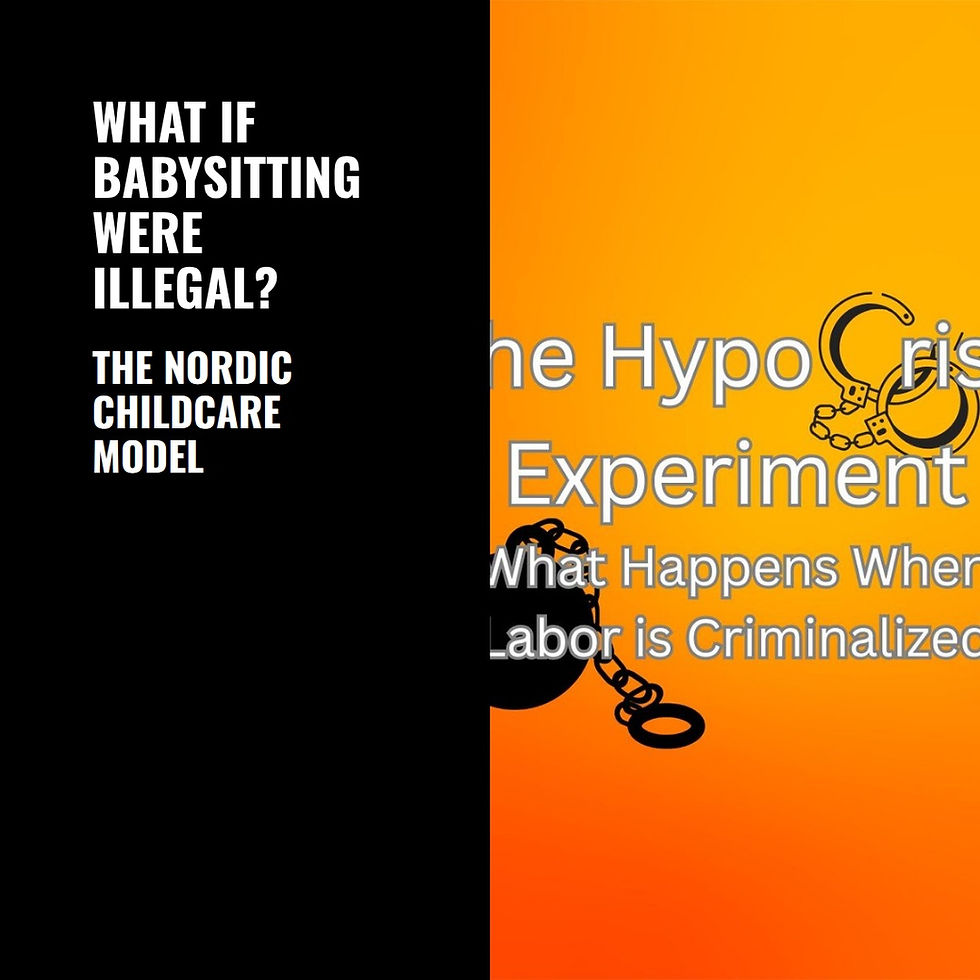
That’s where April’s thought experiments cut through the noise. When we applied the same policy logic to other industries - construction, childcare, lawn care - the contradictions became harder to ignore. Imagine criminalizing one side of a transaction in those fields while claiming the goal is safety. Jobs would move underground. Workers would lose the ability to screen conditions. Safety protocols would be treated as evidence of wrongdoing.
We don’t accept those outcomes in other industries. We recognize them as dangerous. But in sex work policy, those same dynamics are often reframed as necessary trade-offs.

Case Study: When “Rescue” Looks Like Arrest
This isn’t theoretical. We can see it clearly in real-world enforcement. Take Polk County’s “Fool Around and Find Out” operation, marketed as a proactive effort to combat exploitation and protect vulnerable people. The messaging emphasized rescue. The visuals emphasized control. But the outcomes tell a different story: dozens of arrests, public exposure through mugshots and press releases, and long-term consequences that follow people into housing, employment, and family stability. If safety is the goal, we have to ask a harder question: safer for whom?
The Pattern We Keep Ignoring
Because this is the gap that keeps repeating across policy, across funding, and across narratives. A policy can be internally consistent. It can be well-intentioned. It can even be widely supported. And it can still produce harm - predictably, consistently, and at scale.
Intent Is Not Evidence
Intent is not evidence. It is not data. It is not an impact. It does not, on its own, reduce violence, increase stability, or improve safety. Outcomes do that.
And when the outcomes indicate increased risk, isolation, or economic instability, the policy's intention becomes irrelevant.
If a policy increases harm, it doesn’t matter what it was supposed to do.

The Question That Comes Next:
So the question we carry into next week isn’t whether these systems mean well. It’s this: If intent isn’t the metric… then what actually is?