
Samuel Little Is Not Your End Demand Success Story

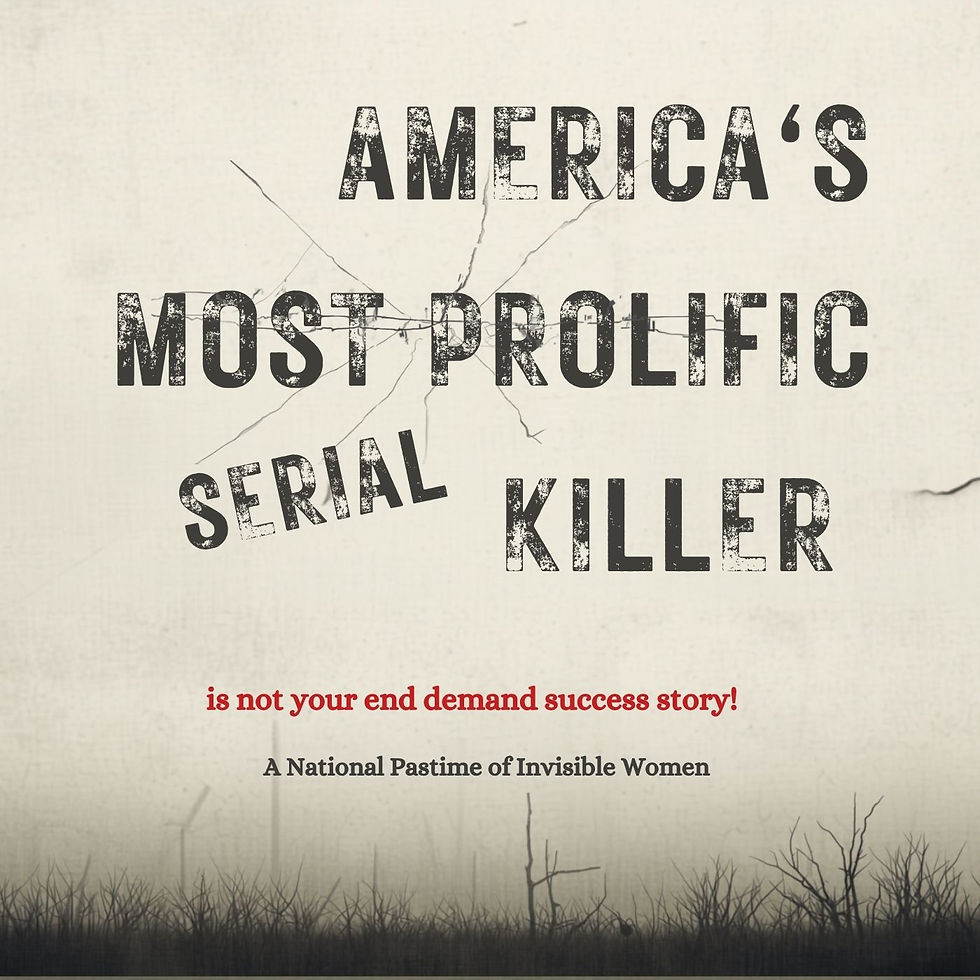
Whenever a serial killer who targeted sex workers is identified, the same political argument inevitably follows. Their crimes, we're told, prove that we need to criminalize buyers. The logic sounds straightforward: if fewer men purchased sex, fewer women would be harmed. It is an emotionally compelling argument because it promises that another criminal law could have prevented unimaginable violence.
But emotionally compelling arguments are not the same as evidence.
America has produced an alarming number of serial killers who discovered the same thing: if you wanted to murder women repeatedly, sex workers were among the least protected victims you could choose, and Samuel Little is not an End Demand success story.
When the FBI concluded that Samuel Little had murdered at least 60 women - and believes the true number may exceed 90—they uncovered something far more troubling than a failure to criminalize buyers. They uncovered a man who understood exactly which women society was least likely to protect.
The Women Society Had Already Decided to Ignore
Little repeatedly targeted women living on society's margins. Many struggled with addiction. Many experienced homelessness. Many lived in poverty. Some exchanged sex for survival. Others drifted through communities where they had already learned not to expect much from the institutions around them.
By his own account, he selected women he believed were less likely to be reported missing, less likely to be identified, and less likely to generate the urgency that accompanies the disappearance of women from more socially privileged backgrounds.
For decades, he was right.
That fact should fundamentally change the conversation. Samuel Little did not exploit a lack of criminal laws. He exploited public indifference. He understood that stigma, poverty, addiction, and criminalization combined to create a class of women whose disappearances could be overlooked long enough for him to continue killing.
Criminalization Was Already the Law
If Little's crimes teach us anything, it is that criminalization alone does not stop serial killers.
During the years he was killing, prostitution was already criminalized across nearly every jurisdiction where he operated. Murder was illegal. Kidnapping was illegal. Sexual assault was illegal. Every violent crime he committed already carried severe criminal penalties.
Yet none of those laws prevented him from murdering women for decades.
The uncomfortable truth is that Samuel Little's success had far less to do with gaps in the criminal code than with the way society viewed his victims. He understood that women burdened by stigma, addiction, poverty, and criminalization were less likely to receive immediate attention from police, the media, or the public.
That calculation became one of his most effective weapons.
The Wrong Question
This is where debates over End Demand strategies often lose sight of the evidence.
The question is not whether serial killers sometimes purchase sexual services. Some clearly have.
The question is whether arresting buyers for solicitation reliably identifies future murderers before they kill.
Those are not the same thing.
Millions of men have purchased sexual services without ever committing homicide. A very small number of serial killers purchased sexual services because doing so gave them access to women they believed society would not protect. Conflating those two groups creates a policy argument that the evidence does not support.
Imagine if Samuel Little had been arrested for solicitation at some point during his decades-long killing spree and then released. Would anyone argue that the system had successfully prevented his murders?
Of course not.
We would recognize that law enforcement had encountered a serial killer without recognizing him as one.
A solicitation arrest is not the same as identifying a violent predator, and using serial killers as evidence for End Demand policies quietly assumes those two things are equivalent. They are not.
What Does the Evidence Show?
Perhaps the most important question is also the simplest.
Where is the evidence that End Demand strategies have prevented serial predators from targeting sex workers?
Countries and jurisdictions that criminalize buyers have not demonstrated that serial offenders no longer target sex workers or that these policies have eliminated the conditions serial predators repeatedly exploit: stigma, isolation, distrust of police, and the marginalization of people living in poverty or survival economies.
At the same time, many sex worker organizations and harm reduction researchers have raised concerns that buyer criminalization changes the way commercial sex occurs. Clients become more reluctant to identify themselves. Negotiations become more hurried. Meetings move to more isolated locations. Workers have less time to screen clients and share information about dangerous individuals.
Whether one agrees with those critiques or not, they deserve to be part of an honest discussion about public safety.
The burden of proof should rest with those claiming a policy prevents violence.
Invoking the names of serial killers is not, by itself, evidence that it does.
The Lesson We Keep Missing
Critics of full decriminalization often ask why sex workers want violent buyers decriminalized.
We don't.
Violence should be prosecuted. Rape should be prosecuted. Kidnapping should be prosecuted. Murder should be prosecuted. Nothing about full decriminalization changes that.
The question has never been whether violent offenders should be punished.
The question is whether sex workers should have more tools to identify dangerous people before violence occurs: the ability to work together legally, maintain bad-date lists, verify identities, hire security, and report suspicious behavior without fearing criminal penalties themselves.
Samuel Little did not thrive because America lacked criminal laws.
He thrived because he correctly believed some women could disappear without immediate alarm.
Every delayed missing-person report.
Every unidentified Jane Doe.
Every assumption that "she probably just moved on."
Every dismissal of a woman because she used drugs or exchanged sex.
Those institutional failures became part of his hunting strategy.
Gary Ridgway.
Robert Pickton.
Samuel Little.
Rex Heuermann.
Different decades. Different countries. Different legal systems.
The same calculation.
Which women has society already decided matter less?
Until we answer that question honestly, we risk learning the wrong lesson.
Samuel Little is not evidence that End Demand works.
He is evidence of what happens when stigma, institutional neglect, and unequal protection make some women easier to hunt than others.


