The Sting Show: Operation Follow The Money

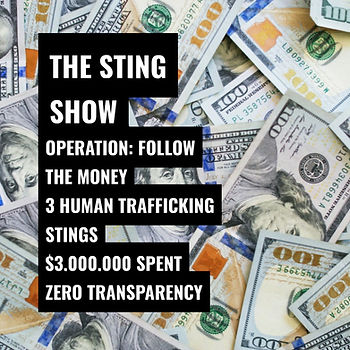
Three Human Trafficking Stings, $3M in Costs, Zero Transparency
Let’s talk about the American tradition of the human trafficking sting - part press conference, part moral panic, part budget sinkhole. Across the country, these branded operations promise to crack down on exploitation and rescue victims.
But when the headlines fade, what are we actually left with? Mostly low-level charges, ambiguous outcomes, and taxpayer-funded theater.

Today, we’re diving into three high-profile case studies:
Operation Hot Spots (Folsom, CA)
Fool Around and Find Out (Polk County, FL)
Operation Burn Notice (Henry County, GA)
Each was sold as a serious anti-trafficking effort. All three relied on big narratives, bigger spending, and PR-ready branding. And not one of them can clearly show it disrupted actual trafficking.

How We Calculated the Costs
Human trafficking stings are expensive - and the public rarely sees the receipts. Since agencies don’t release itemized budgets, we built conservative cost models using:
Local news reporting, booking data, and court records
Known staffing levels and standardized pay/benefits rates
Publicly documented tactics (decoy operations, press briefings, multi-agency involvement)
Comparable past stings with disclosed budgets

Law enforcement sting costs are driven by:
Undercover operations: Long shifts (usually overtime), decoy comms, hotel/rental logistics
Surveillance teams: On-ground, digital, and mobile units
Supervisory staff: Sergeants, lieutenants, and command staff for real-time oversight
Digital forensics: Device triage, data extraction, secure evidence handling
Fleet/facilities: Vehicles, fuel, unmarked units, burner phones, surveillance spaces
Multi-agency duplication: Legal reviews, shared command posts, extra admin overhead
Public information officers (PIOs): Press conferences, media prep, headline handling
All told, these efforts can run $10,000 to $30,000+ per arrest - whether or not a trafficking charge ever materializes.

Case Study 1: Hot Spots (Folsom, CA)
In 2020, Folsom Police closed out Operation Hot Spots, a four-year multi-agency effort labeled a human trafficking crackdown. In its final run, it netted 13 arrests. Across four years? Just 46.
What the public saw:
Arrests of “buyers” and some sex workers
One “juvenile discovered” with no clarification
Zero confirmed trafficking charges
Zero public outcomes related to victim services
Then? The operation disappeared. The Hot Spots name was quietly retired - maybe in step with California’s shift to victim-centered policy, or maybe because it was all optics and no substance.
Estimated Law Enforcement Cost (4 Years) | |
Planning, Training, Ops, Supervision | $1,130,000 |
Total Arrests | 46 |
Average Cost per Arrest | $24,500 |
Confirmed Trafficking Charges | 0 |
Public Victim Outcomes | None |
Nonprofit Partner | Sacramento Together (now defunct) |
Bottom Line: A million-dollar sting dressed up as rescue - with no evidence of rescue, support, or disruption.

Case Study 2: Burn Notice (Henry County, GA)
Henry County’s Operation Burn Notice was a polished, multi-agency effort led by the GBI, Homeland Security, and local police. Months of planning, all-star press release, and... 17 arrests - mostly for seeking sexual services from an consenting adult posing as a police officer.
One trafficking charge showed up in reports. No one followed up.
Estimated Law Enforcement Cost | ≈ $393,000 |
Arrests | 17 |
Average Cost per Arrest | $23,100 |
Trafficking Charges? | 1 (unconfirmed) |
Service Transparency | Zero |
Burn Notice wasn’t a cartoonish mass-arrest spectacle - it was clean, corporate, and incredibly vague about any actual anti-trafficking impact.

Sequel: Operation Johns and Bonds
In September 2025, Henry County ran another sting - this time, arresting five men for soliciting erotic services from a police officer posing as an adult consensual sex worker, including a Customs agent, jailer, and high school teacher. One woman was “recovered” and referred to services, but again, no follow-up, no victim data, and no trafficking prosecutions.
Officials say 30 pandering arrests have occurred since July 2025. What they haven’t said: whether any of it resulted in actual trafficking disruption.
We’ll be examining Henry County’s nonprofit partners and spending flows in our upcoming Nonprofit Ledger series. Spoiler: The budgets may not hold up to scrutiny.
Bottom Line: Two stings. Multiple agencies. Nearly half a million dollars spent. No public evidence of trafficking victims identified or helped.

Case Study 3: Fool Around and Find Out (Polk County, FL)
Because you just can’t talk about trafficking without bringing up the embarrassingly theatrical operations out of Polk County under Sheriff Grady Judd, where mugshots substitute for evidence and slogans replace outcomes.
Polk County has turned stings into a brand.
The latest “Fool Around and Find Out” operation was marketed as a trafficking intervention. It was really a high-volume solicitation sweep.
Officials claimed between 100 and 200 arrests - but the vast majority were prostitution-related misdemeanors. No trafficking prosecutions were detailed. Services were “offered,” but never documented.
Estimated Law Enforcement Cost | ≈ $1.73 million |
Arrests | 100–200 |
Cost per Arrest | $8,600–$17,250 |
Trafficking Disruption? | Unclear |
Service Outcomes? | None reported |
Nonprofit Partners? | Yes - details coming soon |
This is spectacle policing at scale. Flashy branding. Press blitz. Mugshot parades. What it lacks is substance, transparency, or confirmed outcomes.
Bottom Line: Millions spent. Arrests made. No measurable safety improvements.
Compare the Cost, Count the Outcomes
Operation | Est. Cost | Arrests | Cost/Arrest | Trafficking Charges? | Victim Data? |
Hot Spots (Folsom, CA) | $1.13M | 46 | $24,500 | 0 | None |
Burn Notice (Henry Co., GA) | $393K | 17 | $23,100 | 1 (unconfirmed) | None |
Fool Around & Find Out (Polk Co., FL) | $1.73M | 100–200 | $8.6K–$17.2K | 0 | None |

If This Is Rescue, Where Are the Rescued?
These stings may look different - different states, different slogans - but they share the same DNA:
High spending
Low transparency
Few trafficking charges
No measurable victim outcomes
They offer a media-friendly illusion of impact, where arrests are equated with justice, and “rescue” is claimed without proof. Meanwhile, the public foots the bill, and the people most vulnerable - often sex workers and buyers in marginalized communities - are criminalized, not supported.
If stings worked - we wouldn’t still be doing them.

The United States has been doing prostitution stings forever. If these stings truly disrupted trafficking, we’d see prosecutions, service outcomes, and survivor support systems. Instead, what we’re seeing is rescue-themed PR with no receipts.
So the next time a sheriff or special agent declares a “major human trafficking bust,” ask:
Who was helped?
Who was harmed?
And who got paid to call it a success?