
Top Ten Myths and Misconceptions About the Adult Industry—And the Truth Behind Them

Updated: Jan 14

Let’s be real—if myths about sex work were dollar bills, every stripper in America would be retired by now, sipping cocktails on a beach somewhere and finally getting paid what she's worth.
But instead of cashing in, sex workers are still stuck cashing out the emotional and legal damage from decades of moral panic and misinformation.

These tired narratives don’t just misinform—they fuel stigma, drive harmful legislation, justify police violence, and shape the way society treats people who trade sex for survival, for empowerment, or simply because it pays the bills. They show up in courtroom rulings, in media headlines, in social services that exclude us, and in public health policies that criminalize our bodies instead of keeping us safe.

What’s worse?
These myths aren’t coming from thin air—they're actively maintained by a toxic mix of political opportunism, sensationalist journalism, and well-funded organizations that confuse morality with human rights.
So, it’s time to bust them wide open—not just with data, but with lived experience, survivor wisdom, and a solid dose of common sense. Because the truth is this: sex workers know what’s best for sex workers. And until policy, public health, and advocacy efforts reflect that reality, we’ve got some serious myth-busting to do. Let’s go.

🔥 MYTH #1: “All sex work is trafficking.”
This myth is not just wrong—it’s dangerously simplistic. It ignores the crucial distinction between consensual labor and coerced exploitation.
Trafficking involves force, fraud, or coercion—or involves minors. Adults who voluntarily engage in sex work do not fall under this definition. Conflating all sex work with trafficking silences the voices of workers advocating for rights, safety, and dignity.
Policies built on this myth lead to increased policing, harmful "rescue" raids, and mass criminalization—none of which protect actual trafficking victims. It’s like outlawing restaurants because some kitchen workers face wage theft. We don't eliminate an entire industry to solve abuse; we fix the abuse directly. Sex workers deserve the same logic.

🧠 MYTH #2: “People can’t consent to sex work.”
This assumption implies that sex workers lack the capacity to make their own choices—a belief steeped in paternalism and disrespect. No one’s labor choices exist in a vacuum. People take jobs based on the options available to them. We accept this logic for military service, mining, and nursing. Sex work should be no different.
Consent doesn’t vanish because money changes hands. Many sex workers exercise more control over their work boundaries than those in mainstream jobs. Denying their autonomy justifies criminalization and stigma. True empowerment means recognizing that people, even those on the margins, can make valid, informed choices.

🦠 MYTH #3: “Sex workers spread disease.”
This myth is rooted in centuries-old stigma and fear. In reality, sex workers are often more knowledgeable and proactive about sexual health than the general public. They regularly test for STIs, use protection, and engage in harm reduction practices.
What truly harms public health is criminalization. In many places, carrying condoms is used as evidence of prostitution, which discourages safer sex practices. When sex workers fear arrest, they avoid healthcare altogether. The real threat isn’t the sex worker—it’s the legal and medical systems that punish them for protecting themselves and their communities.

🌍 MYTH #4: “All sex workers are street-based, poor women of color.”
While it’s true that marginalized communities face disproportionate criminalization, sex work is incredibly diverse. Workers come from all racial backgrounds, gender identities, and socioeconomic classes. They work on the street, in strip clubs, online, in private venues, and more.
Reducing sex work to a single stereotype invites policies based on pity and punishment rather than empowerment and support. It also erases the existence of sex workers who don’t fit the "rescue narrative," making it harder for them to access resources or be taken seriously. Real support must reflect real diversity.

👶 MYTH #5: “Everyone entered sex work as minors.”
This myth, often repeated without question, is based on flawed research and moral panic. While some minors are trafficked and deserve protection, most people enter the sex trade as adults. Conflating all adult sex workers with exploited children infantilizes them and invalidates their choices.
This myth fuels carceral policies that harm both minors and adults. Arresting or "rescuing" people en masse doesn't address root causes—it just pushes them further underground. We need age-appropriate, rights-based, trauma-informed responses—not blanket assumptions.

🧙♂️ MYTH #6: “Traffickers are always strangers in dark vans.”
Thanks to Hollywood, many believe trafficking is about random abductions. In reality, traffickers are often intimate partners, family members, or trusted employers who use psychological and economic control.
When we focus only on sensational narratives, we miss the real signs of trafficking and waste resources on ineffective "stranger danger" policing. Real solutions lie in addressing the conditions that allow coercion to thrive: poverty, instability, discrimination, and a lack of social safety nets.

🧪 MYTH #7: “Sex workers are all addicts or mentally ill.”
Yes, some sex workers live with mental illness or struggle with addiction—just like people in every profession. But pathologizing all sex workers is both lazy and harmful. It ignores the many reasons people enter sex work: economic opportunity, flexible hours, autonomy, or even enjoyment of the work.
This myth gets weaponized to justify coercive policies like forced rehab, parenting restrictions, or surveillance. It also deters sex workers from seeking help when they need it. True support means listening without judgment, not diagnosing people for surviving in a hostile world.

📉 MYTH #8: “Decriminalization causes more trafficking.”
Evidence from countries like New Zealand shows the opposite. Decriminalization makes sex work safer. It allows workers to report abuse, access healthcare, and organize for their rights. It helps distinguish consensual work from actual trafficking.
Criminalization, on the other hand, drives the industry underground and makes it easier for traffickers to operate with impunity. It puts everyone—consensual workers and trafficking survivors—at greater risk. If we truly want to prevent trafficking, we must support decriminalization and address root causes like poverty, housing instability, and immigration barriers.

♀️ MYTH #9: “You can’t be feminist and support sex work.”
Feminism without bodily autonomy is just patriarchy with a pink ribbon. Supporting sex workers means respecting their right to control their own bodies, labor, and livelihoods. It means trusting them to know what liberation looks like in their own lives.
The idea that feminism must exclude sex workers is rooted in respectability politics and a narrow, often white, middle-class view of empowerment. But sex workers have always been at the front lines of feminist struggles—fighting for housing, healthcare, parental rights, and freedom from violence. If your feminism doesn’t include sex workers, it’s time to rethink who it’s really serving.
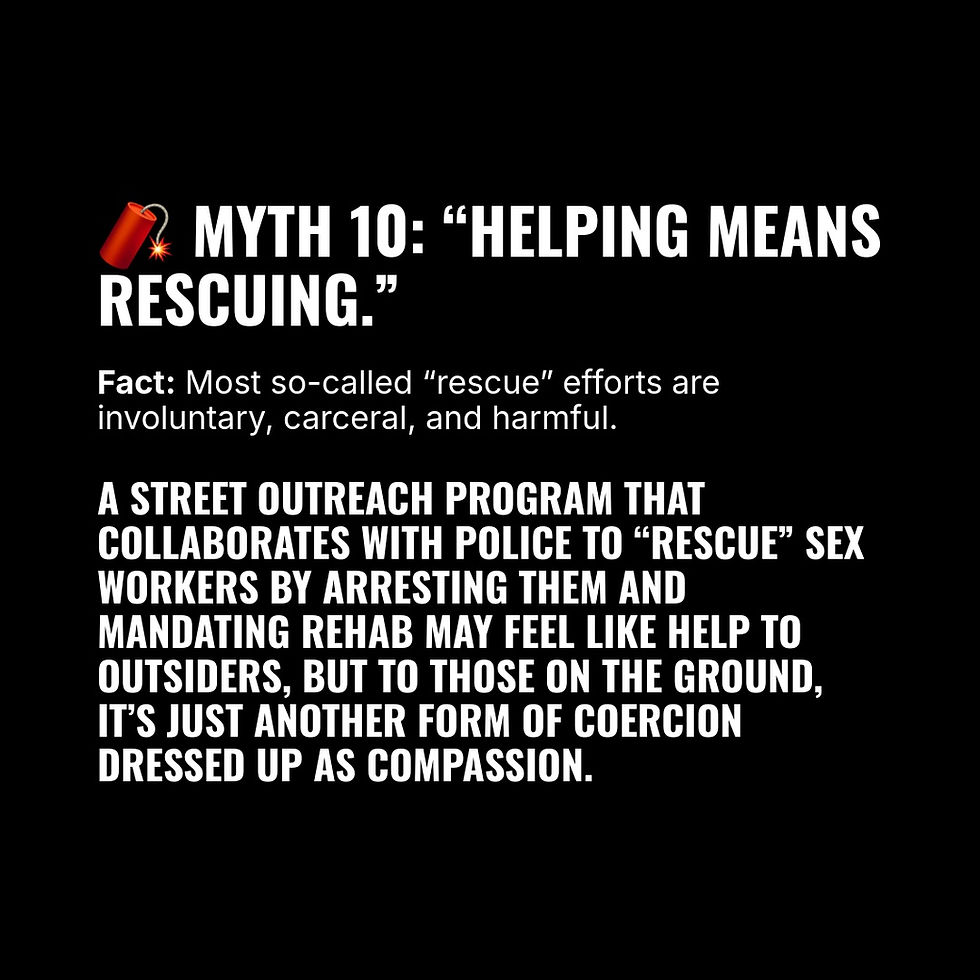
🛑 MYTH #10: “Helping means rescuing.”
This myth treats sex workers and trafficking survivors as people to be “saved,” often through force, arrest, or coercive programs—rather than supported with resources, respect, and choice. Under the banner of “rescue,” sex workers are routinely handcuffed, detained, or funneled into mandatory services they never asked for.
This doesn’t promote safety—it just replaces one form of control with another.
Real support centers autonomy, not saviorism. If your help requires taking away someone’s agency, it’s not help—it’s harm with good PR.
🔍 THE BOTTOM LINE
Myths about sex work aren’t just annoying—they’re dangerous. They shape policy, public opinion, and how people are treated by police, courts, healthcare systems, and their own communities. They silence sex workers, criminalize survival, and let real harm go unchecked.
But it doesn’t have to be this way.
When we center sex workers' lived experiences, when we listen to survivors, and when we move from fear-based fantasies to reality-based reforms, we create a world where everyone—regardless of how they make a living—can access safety, dignity, and respect.
It’s time for unity. Time for compassion. Time to retire these myths for good and replace them with truth, justice, and solidarity.

Sex workers are not the problem. Criminalization is.Let’s build something better—together.
BONUS INFORMATION
💥 Why These Myths Are Dangerous
Myths don’t just sit quietly in the background—they:
Justify criminalization and surveillance
Fuel harmful “rescue” operations
Deny access to healthcare and housing
Silence survivor-led solutions
Marginalize those who don’t fit the “perfect victim” mold
🎤 Centering Sex Workers and Survivors
Organizations like SWOP Behind Bars, NSWP, SWAN Vancouver, and Sex Workers Project know what works:
Peer-led support
Access to non-judgmental services
Policy rooted in lived experience
Clear distinctions between consensual work and coercion
When we listen to those directly affected, we get better outcomes. Period.
✅ What You Can Do
🔹 Stop sharing sensationalized trafficking stories that conflate all sex work with abuse.
🔹 Follow and fund sex worker-led orgs.
🔹 Support decriminalization and labor rights.
🔹 Challenge stigma in conversations—yes, even at brunch.
🔹 Learn the difference between saving and supporting.
One involves ego. The other, equity.
Sex workers aren’t a myth. But the stories told about them too often are. It’s time to stop letting ignorance set policy. Let’s build a world where safety, dignity, and self-determination come standard—no matter how someone earns a living.


