
Feminism Isn’t Just One Thing: Second-Wave Feminism, When the Personal Became Political


Understanding the different waves of feminism matters because feminism is not a single idea, strategy, or moral position - it is a long history of debates about power, inclusion, and what real change entails.
Each wave emerged in response to the limits and failures of the preceding wave, carrying forward both progress and unresolved harm. Without this context, today’s feminist disagreements can appear as personality clashes or generational infighting, when they are in fact deeply rooted political tensions: access versus transformation, protection versus autonomy, representation versus redistribution.

Feminism is Not a Single Idea
Tracing the waves helps us see why certain arguments keep resurfacing, why no single wave “solved” feminism, and how earlier strategic choices - about who to center, who to exclude, and what compromises to make - continue to shape feminist politics today.
The wave framework is imperfect and incomplete, but it remains a useful map for understanding where feminism has been, what it continues to get wrong, and why this conversation remains unfinished.

Second-wave feminism emerged in the 1960s not because first-wave feminism had “finished the job,” but because its victories exposed how much work remained undone.
Women could vote, in theory. They could own property, on paper. But in daily life, their bodies, labor, and private lives were still tightly controlled. The promise of equality stopped at the courthouse door and fell apart in kitchens, bedrooms, workplaces, and doctors’ offices.
Second-wave feminism expanded the scope of feminist struggle beyond formal legal rights and into the terrain of everyday life. Its central insight - that the personal is political - was radical at the time. It insisted that what happened inside homes, marriages, workplaces, and bodies was not individual failure or private misfortune, but the result of structural inequality.
Patriarchy wasn’t just enforced by the state; it was reproduced through gender roles, economic dependency, sexual norms, and violence that had long been treated as “normal.”

What Second-Wave Feminism Took On
Second-wave feminists tackled issues that had been deliberately kept off the political agenda. Workplace discrimination and unequal pay were named as systemic problems rather than personal shortcomings. Reproductive rights and access to contraception became central demands, reframing motherhood as a choice rather than a destiny. Sexual violence and domestic abuse were dragged into public view, challenging the long-standing belief that what happened to women in private was no one else’s business.
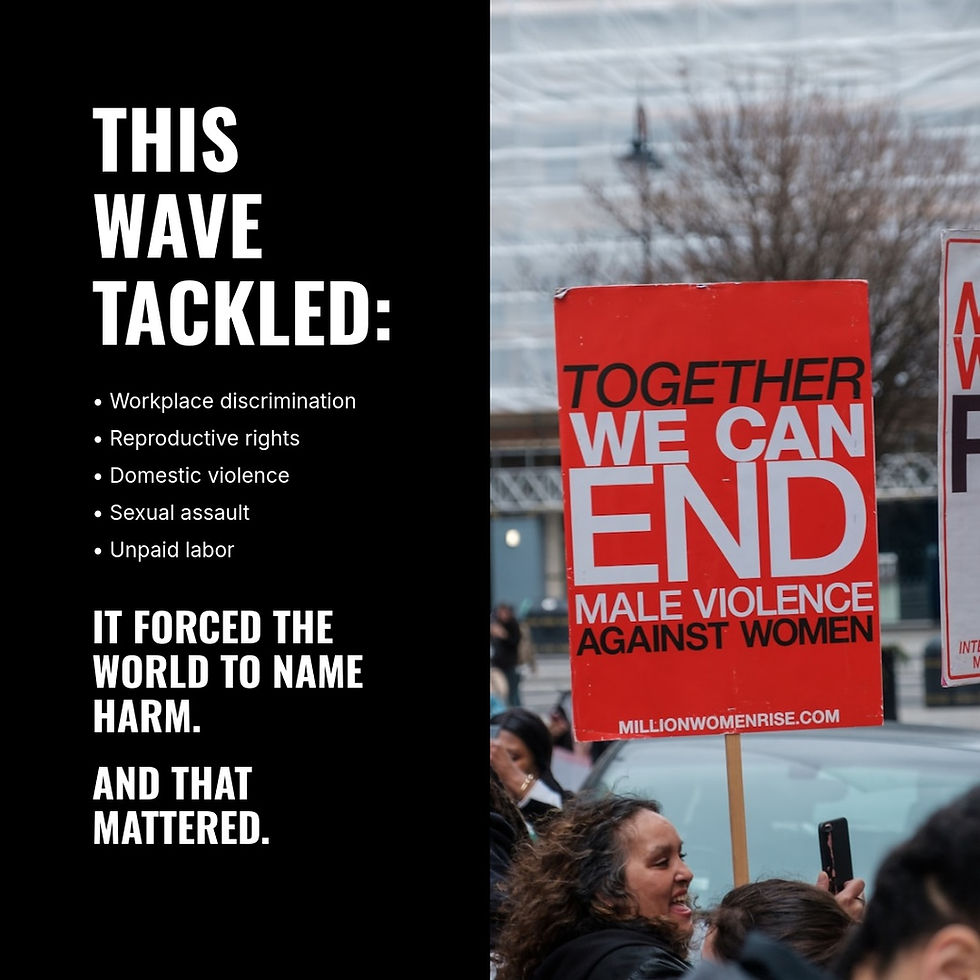
This wave also interrogated marriage, family structures, and unpaid labor, exposing how women’s economic dependence was sustained through caregiving and domestic work that went unrecognized and uncompensated. For many women, this was the first time their daily exhaustion, fear, or dissatisfaction was framed as political rather than as something they were expected to endure quietly.
How It Differed From the First Wave
Where first-wave feminism focused on access to citizenship and formal rights, second-wave feminism focused on lived inequality. It challenged patriarchy not only in law but also in culture. Not only in government but also in homes. Sexuality, reproduction, and labor were no longer treated as personal choices or moral issues - they were recognized as sites of power.
This shift mattered. It gave women language to name harm that had long been dismissed or normalized. It produced shelters, hotlines, consciousness-raising groups, legal reforms, and cultural change that saved lives.
The tools developed during this period - particularly around gender-based violence and reproductive autonomy - remain foundational.

The Fractures Inside the Movement
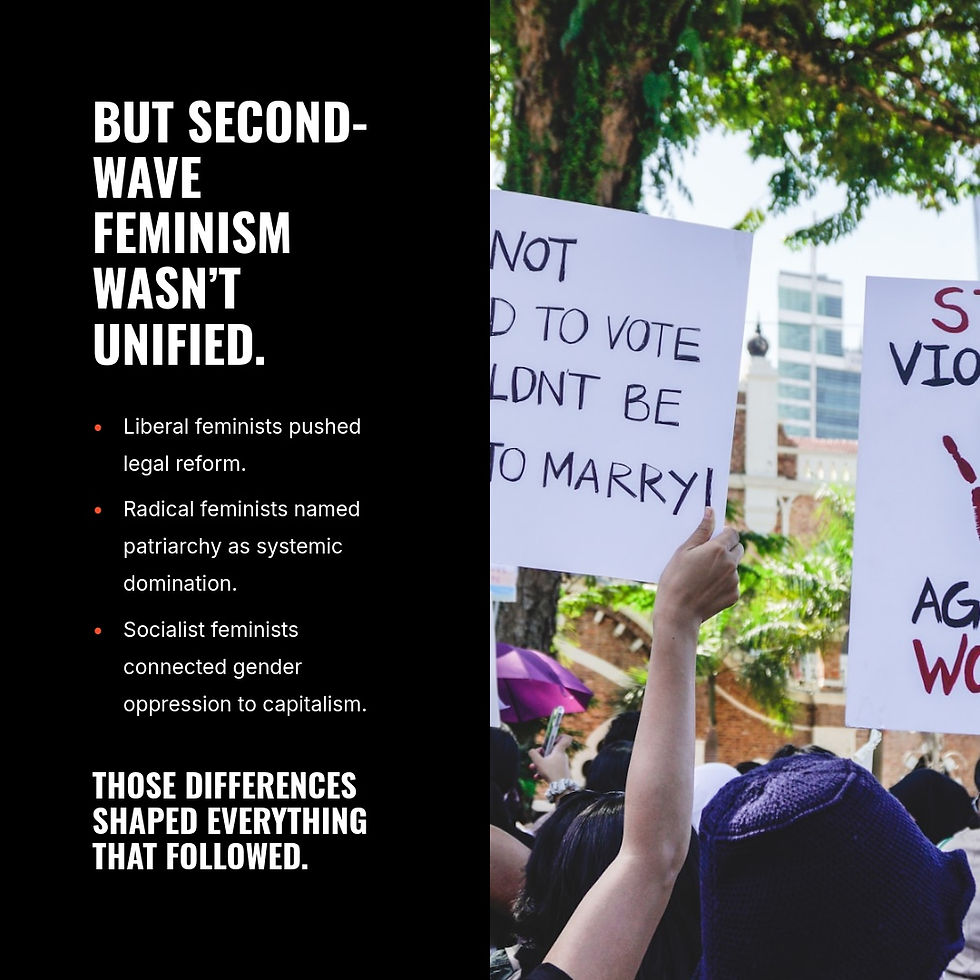
At the same time, second-wave feminism was never a single, unified movement. It fractured along ideological lines that shaped its legacy. Liberal feminists pursued legal reform, workplace integration, and equal opportunity within existing systems. Radical feminists argued that patriarchy was a fundamental system of male dominance rooted in sexuality, violence, and control over women’s bodies. Socialist feminists linked gender oppression to capitalism, pointing to economic structures that relied on women’s unpaid and underpaid labor.
These debates were not merely theoretical - they shaped policy priorities, organizing strategies, and who was considered a “real” feminist. And they often played out through exclusion.

Who Was Left Out - and Actively Pushed Aside
Second-wave feminism was repeatedly challenged by Black feminists, Indigenous feminists, and women of color who pointed out that the movement’s dominant narratives centered white, middle-class women and treated racism, colonialism, and poverty as secondary issues. Lesbian feminists fought for recognition in a movement that often treated heterosexual marriage as the default problem to be reformed. Sex workers were frequently framed only as victims or symbols of patriarchal harm, rather than as people with agency, labor rights, or political analysis of their own.
Respectability politics hardened during this era. Moral hierarchies emerged around sexuality, motherhood, and “acceptable” forms of womanhood.
In trying to name harm, parts of the movement slipped into policing behavior.
In trying to protect women, they sometimes reproduced control.
What Second-Wave Feminism Solved - and What It Broke
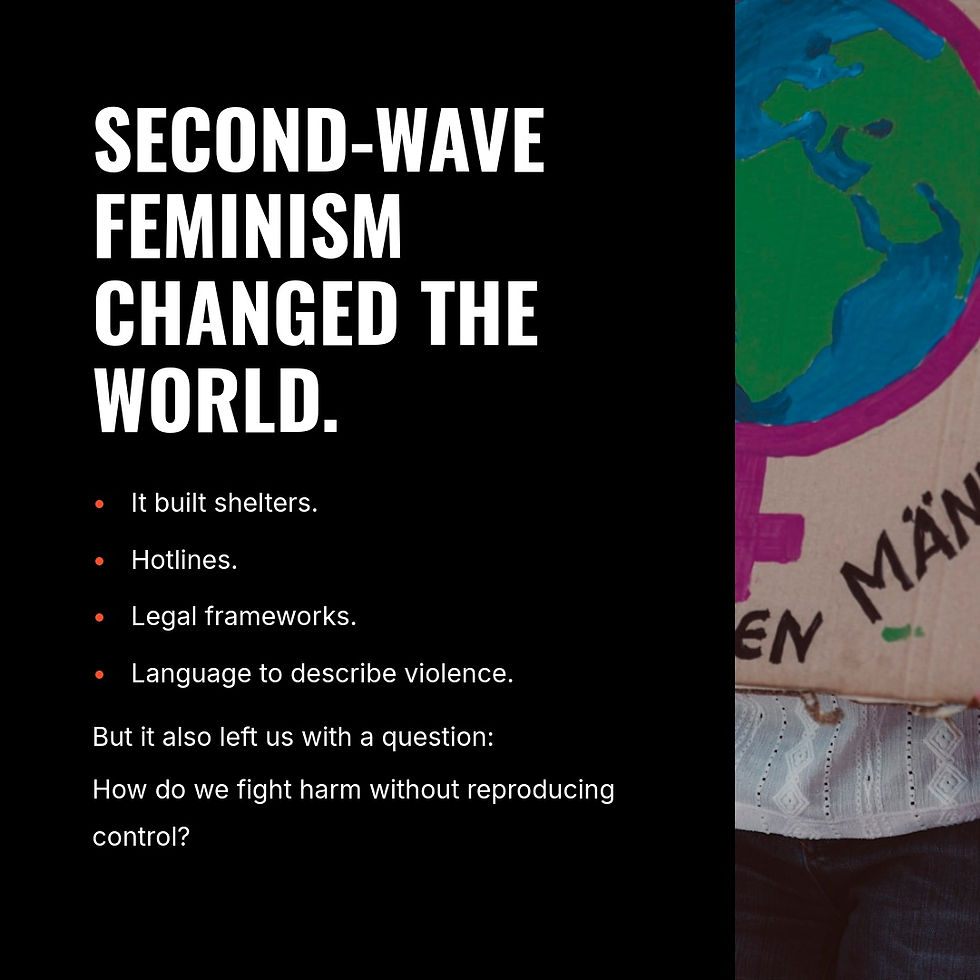
Second-wave feminism changed the world. It forced conversations that could not be put back in the box. It created frameworks for understanding gender-based violence, reproductive autonomy, and workplace discrimination that are still in use today. It made it possible to state publicly that what happens to women in private is shaped by power.
But it also entrenched divides that later movements would struggle to repair. By universalizing certain experiences and sidelining others, it reinforced the idea that feminism could speak for women rather than with them. By centering protection without always centering autonomy, it laid the groundwork for carceral and moralistic approaches that continue to haunt feminist policy today.
Second-wave feminism cracked patriarchy open inside the home and the body. It named truths that had long been buried.

But it also left behind a hard question that feminism has yet to fully resolve:
How do we fight harm without reproducing control?
The tools were powerful.
The analysis was partial.
The legacy - like feminism itself - is unfinished.

Fund liberation - not optics.
Your donation supports feminist work rooted in lived experience, accountability, and real-world impact - not polished talking points.

The Pink Patriarchy series asks hard questions about respectability politics, corporate and nonprofit feminism, carceral “solutions,” and the gap between progressive language and real-world outcomes. By tracing these dynamics across history, policy, and lived experience, the series aims to move beyond feel-good feminism and toward something more honest, accountable, and liberatory.
