
The Pink Patriarchy: When Feminism Starts Policing Women


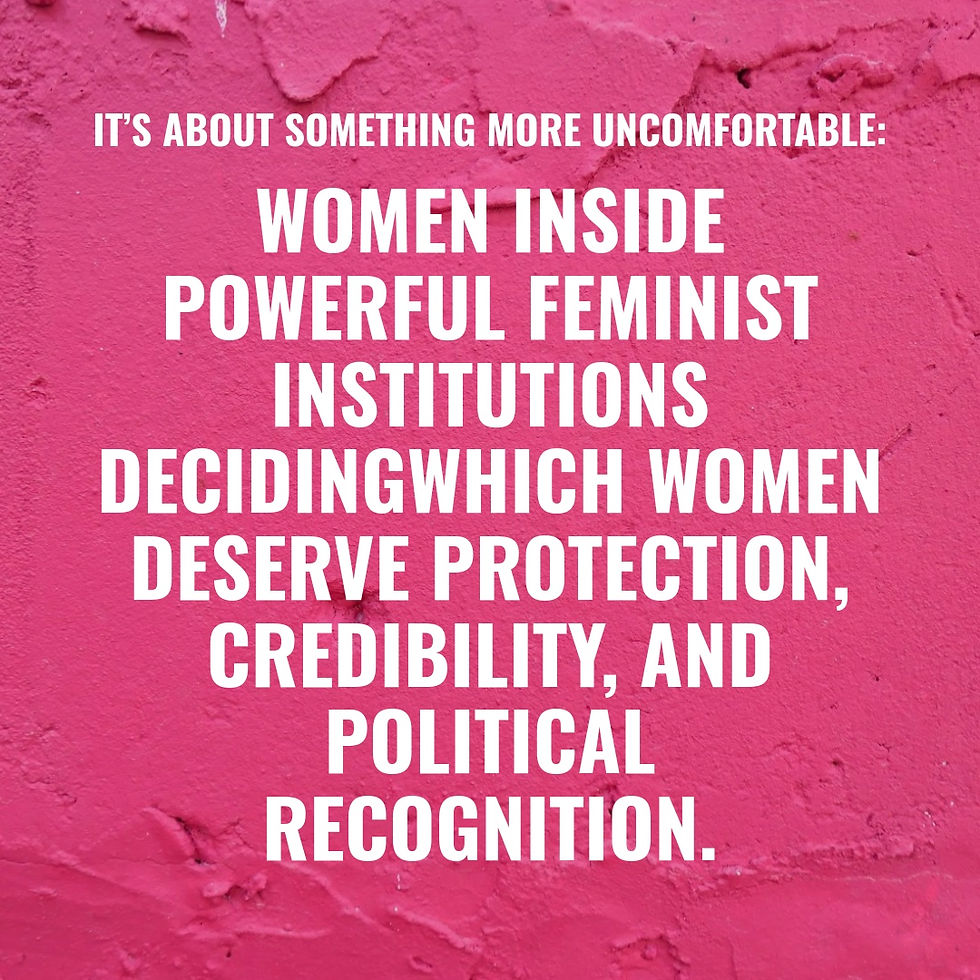
The Pink Patriarchy is not about men secretly controlling feminism from behind the curtain. It is about something more complicated - and more uncomfortable. Certain women inherit the institutional authority once reserved for patriarchal leadership and use it, often unintentionally, to determine which women deserve protection, credibility, and political recognition.
Within mainstream feminist institutions, power flows through nonprofits, advocacy organizations, academic networks, and policy circles. These structures determine who receives funding, who appears in media, and whose voices shape legislation.
The women who rise within these systems often become the public face of feminism. Many began their careers fighting real injustice. But institutional power has a way of reshaping how problems are framed - and whose voices are treated as legitimate.
That shift is where the Pink Patriarchy begins.

When Feminist Leadership Starts to Look Like Gatekeeping
For decades, the National Organization for Women (NOW) has been one of the most recognizable feminist organizations in the United States. Founded in 1966, NOW helped secure major victories - workplace equality, reproductive rights, anti-discrimination protections, and broader recognition of women’s autonomy. Many of the rights women rely on today were built through organizing power that groups like NOW helped create.
But institutions - even feminist ones - do not escape the gravitational pull of power.

Over time, many sex workers, trans women, incarcerated women, migrant workers, and others living under criminalization have found themselves outside the feminist circle that NOW claims to represent. The language of inclusion remains, but the policies often draw a quieter boundary around who counts as “all women.”
It is also important to recognize that NOW is not a monolith. The organization operates through a network of local and state chapters that often reflect the politics of the communities they serve. In many cases those chapters are more diverse - and sometimes more progressive - than national leadership. Grassroots members regularly push the organization to evolve on issues like LGBTQ+ rights, criminal justice reform, and sex worker inclusion.
That internal tension is real: national policy often moves cautiously while local chapters grapple with these realities in their own communities.
The same tension became visible during the rise of the Women's March. When millions of people flooded the streets in 2017, it looked like the beginning of a broad feminist coalition - one capable of bringing together women across race, class, sexuality, immigration status, and labor.
But sustaining that coalition proved far harder than launching it.
Leadership conflicts, accusations of exclusion, and unresolved disagreements about policing, criminalization, and sex work quickly exposed long-standing fractures within mainstream feminist spaces. What began as a moment of unity became a reminder of how difficult it is for large movements to hold space for women whose lives fall outside respectability politics.

The problem is not simply hypocrisy or bad intentions. The problem is structural.
When feminist institutions anchor themselves to political respectability, philanthropic funding, and policy narratives designed to appeal to lawmakers, some women inevitably become easier to represent than others. Women whose lives complicate those narratives - sex workers, criminalized survivors, undocumented women, and those navigating survival economies - often get pushed to the margins of movements that still claim to speak in their name.
That gap between who feminism says it represents and who actually holds power is where the Pink Patriarchy lives.
Institutional Feminists
Many influential feminist leaders built their careers inside large advocacy organizations, philanthropic foundations, and national policy networks. These institutional feminists shape messaging, legislation, and the policy frameworks that define mainstream feminism. With those positions comes influence: deciding which issues receive funding, which organizations gain visibility, and which perspectives are treated as credible in public debate.
But institutions come with incentives.
Advocacy organizations must maintain relationships with donors, policymakers, and media outlets. As a result, the feminism that emerges from these spaces often prioritizes policies that are politically palatable and easy to communicate. Women whose lives complicate those narratives - sex workers, criminalized mothers, undocumented workers, incarcerated survivors - are often treated as political liabilities rather than experts in their own experiences.
The language of inclusion may remain. But the decision-making power rarely shifts.

Carceral Feminists
Another group reinforcing the Pink Patriarchy are feminists who view the criminal legal system as the primary solution to gendered harm. Often referred to as carceral feminists, these advocates place strong faith in policing and prosecution as tools for protecting women.
Their frameworks typically emphasize expanded criminal penalties related to sexual exploitation, greater police involvement in sex markets, and “end demand” approaches such as the Nordic Model.
Prominent supporters of these ideas include Gloria Steinem, Julie Bindel, Melissa Farley, and former NOW president Toni Van Pelt. Many of these leaders have spent decades advocating for women’s rights and drawing attention to gender-based violence. Their contributions are real. But their frameworks around sex work often begin with a fixed premise: that prostitution itself is inherently violence against women. Once that assumption is accepted, the voices of people currently working in the sex trade become politically inconvenient. Sex workers are then positioned not as participants in the debate, but as subjects of it - spoken about, studied, rescued, and regulated, but rarely invited to shape the policies governing their lives.

How Pink Patriarchy Shows Up in Practice
The Pink Patriarchy rarely appears as open hostility. Instead, it operates through familiar patterns.
One is speaking about sex workers rather than with them. In policy debates, sex workers are often framed as victims in need of rescue or used as evidence to justify legislation. What they rarely are is decision-makers.
Another is the reliance on protection narratives that replace listening. Policies like the Nordic Model are framed as compassionate compromises - punishing buyers rather than sellers. Yet evidence from countries where these laws exist repeatedly shows increased surveillance, reduced ability for workers to screen clients safely, housing discrimination, and deeper stigma.
The intention may be protection. The outcomes often increase vulnerability.
Respectability politics also plays a role. Empowerment becomes associated with professional success, institutional legitimacy, and distance from stigmatized labor. Women navigating survival economies are treated not as leaders but as problems to be solved.
How Did Feminism Get Here?
This shift did not happen because feminist leaders suddenly became villains. It happened because institutions reward certain kinds of feminism.
Large advocacy organizations depend on funding, political partnerships, and media narratives that resonate with mainstream audiences. To maintain that support, they gravitate toward policies that are easy to explain and politically acceptable.
Sex workers complicate those narratives.
Recognizing sex worker leadership requires confronting uncomfortable truths: that criminalization often harms the people it claims to protect, that policing can function as a source of violence rather than safety, and that survival economies are deeply tied to housing instability and economic inequality.
Those conversations are complex. Rescue narratives are simple. Institutions often choose simplicity.

Can These Feminists Be Brought to the Table - And Do We Even Want Them?
That question deserves an honest answer.
For many sex workers, survivors, and criminalized women, the instinctive reaction is frustration. After decades of exclusion and policies designed without their input, the idea of “bringing these feminists to the table” can feel backwards. Why should the communities most harmed by these policies be responsible for educating the institutions that helped create them?
And yet, those institutions still shape funding, policy, and public narratives.
Ignoring them does not make their influence disappear.
But if dialogue is going to happen, it cannot be symbolic.
Real change requires shifting from token participation to shared power. Inviting sex workers to speak on panels does not change how policy is written. Meaningful inclusion means funding sex worker-led organizations, including them in governance structures, and recognizing lived experience as expertise.
It also means shifting debates away from moral narratives and toward evidence. Across multiple countries, research increasingly shows that decriminalization improves safety outcomes while criminalization increases vulnerability. Peer-led services consistently reach communities that traditional institutions struggle to serve.
Most importantly, it requires reconnecting feminism with its own principles: bodily autonomy, labor rights, harm reduction, and skepticism toward state violence.
Those principles cannot apply selectively.
When they are applied consistently, the exclusion of sex workers becomes far harder to defend.
The question, then, is not simply whether these feminists can come to the table. It is whether they are willing to sit at a table where they are no longer the only ones holding power.

The Real Question
The Pink Patriarchy is not a conspiracy. It is a warning.
When feminist institutions become more focused on protecting their legitimacy, funding streams, and political influence than on listening to the women most affected by their policies, they risk reproducing the very hierarchies they once sought to dismantle.
Many mainstream feminist leaders entered this work with genuine intentions.
But intentions are not the measure of a movement’s success.
The real question is simpler - and more uncomfortable:
If feminism claims to speak for all women, who ultimately gets to decide which wo

Fund liberation - not optics.
Your donation supports feminist work rooted in lived experience, accountability, and real-world impact - not polished talking points. Donate to SWOP Behind Bars today at www.swopbehindbars.org


