
Third-Wave Feminism: Identity, Agency, and the Turn Toward the Individual


Third-wave feminism emerged in the 1990s as both a continuation of and a reaction against the second wave.
By this point, many of the second wave’s gains - legal protections against discrimination, expanded access to education and employment, and public conversations about violence and reproduction - were formally in place. But it was increasingly clear that those victories had not translated into liberation for everyone.
The dominant feminist narrative is still centered on white, heterosexual, middle-class women and treats race, sexuality, class, disability, and culture as side issues rather than foundational ones.
Third-wave feminism arose from that frustration. It rejected the idea that there was a single, universal “woman’s experience” and insisted instead on plurality, contradiction, and self-definition.
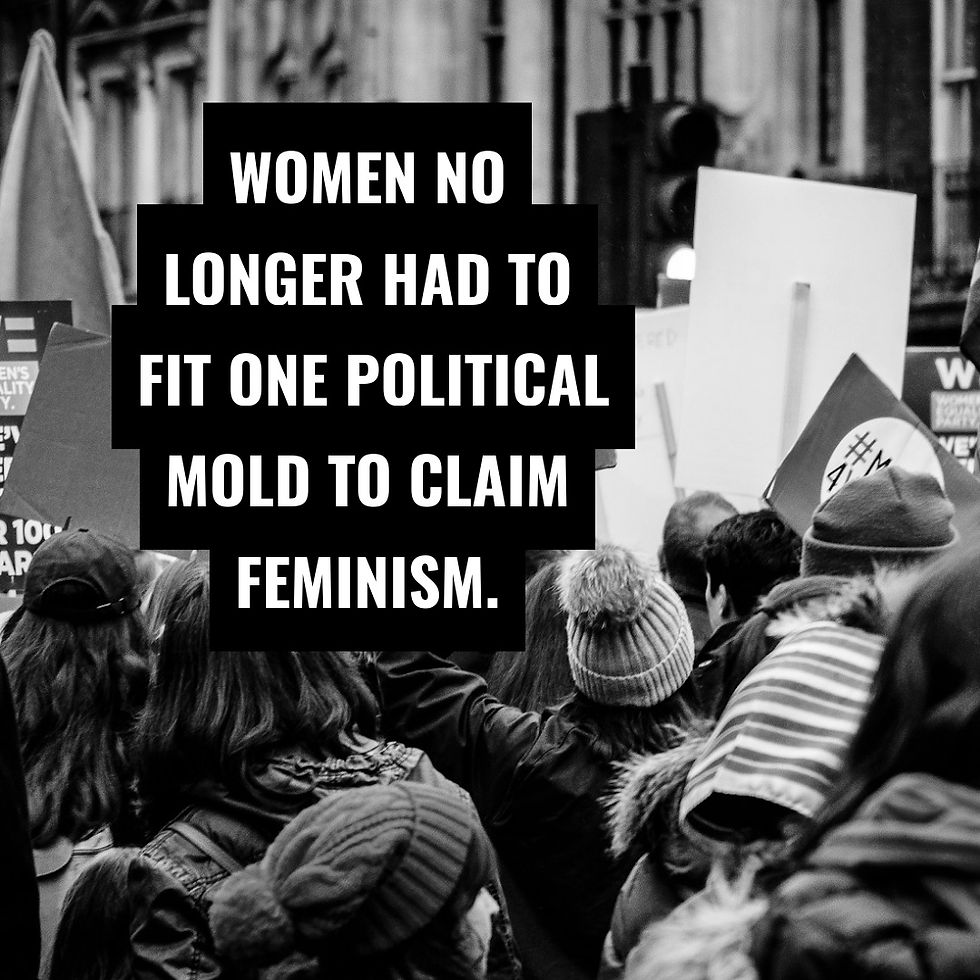
Rather than asking women to fit into a shared political identity, it asked feminism to make room for difference - even when that difference was messy, uncomfortable, or resistant to consensus.

What Third-Wave Feminism Took On
At its best, third-wave feminism expanded the scope of feminist analysis in critical ways. It foregrounded intersectionality, a framework developed by Black feminists to explain how race, gender, class, and other systems of power intersect - though the term itself was often flattened or stripped of its political roots as it entered mainstream feminist discourse. Third-wave feminists pushed for recognition of queer and trans identities, challenged rigid definitions of womanhood, and rejected the idea that empowerment had to look respectable, palatable, or morally approved.
This wave also reclaimed conversations about sexual agency, pleasure, and desire.
Where earlier feminist debates often centered on harm, risk, and protection, third-wave feminism insisted that women could be subjects of desire rather than merely objects of it. Choice, self-expression, and bodily autonomy were emphasized - not as abstract ideals, but as lived experiences shaped by culture, identity, and context.
How It Differed From the Second Wave
Third-wave feminism marked a clear departure from the second wave’s tendency to universalize women’s experiences. It was skeptical of rigid ideology, centralized leadership, and single-issue frameworks. Instead of insisting on shared political conclusions, it embraced ambiguity and contradiction. A woman could be feminist and still enjoy things that previous movements had critiqued. She could claim identities that didn’t fit neatly into established categories.
Feminism no longer demanded coherence; it tolerated - and sometimes celebrated - complexity.

This shift opened important doors. It allowed more people to see themselves reflected in feminist spaces. It challenged the idea that feminism required conformity to a particular lifestyle, sexuality, or moral code. For many, it felt like a release from the constraints and judgments of earlier movements.
The Strengths - and the Slippage
But the same turn toward individuality that expanded feminism’s reach also weakened its structural analysis. As third-wave feminism emphasized personal narrative, self-definition, and cultural expression, political critique sometimes gave way to personal branding. Feminism became something you were rather than something you did. Identity became a stand-in for politics. Structural power - capitalism, the state, policing, economic exploitation - often faded into the background.
In distancing itself from prescriptive frameworks, third-wave feminism sometimes lost its ability to articulate collective demands.
Without shared goals or strategies, feminism risked becoming diffuse - powerful in expression but limited in enforcement. The language of choice and empowerment, once used to challenge constraint, became increasingly easy to co-opt.

What Third-Wave Feminism Left Behind
Third-wave feminism laid the essential groundwork for contemporary feminist thought. It normalized conversations about gender fluidity, queerness, pleasure, and identity. It challenged exclusionary definitions of womanhood and expanded the range of people to whom and with whom feminism could speak. These contributions were not cosmetic - they reshaped feminist culture and discourse in lasting ways.
At the same time, this wave helped create the conditions for the commodification of feminism. When politics became personal expression, it became marketable. Empowerment could be sold. Identity could be branded. Feminism could be worn, posted, and consumed without requiring confrontation with systems of power.

Third-wave feminism cracked open the idea that there was only one way to be a woman - or a feminist. But in loosening the structure, it also raised a question that feminism is still grappling with today:
What happens when liberation is defined primarily at the level of the individual, while the systems shaping those individuals remain intact?
The expansion was real.
The critique was necessary.
The consequences were complicated.
And those complications are exactly what the next wave - and the Pink Patriarchy - would inherit.

Fund liberation - not optics.
Your donation supports feminist work rooted in lived experience, accountability, and real-world impact - not polished talking points.
The Pink Patriarchy series asks hard questions about respectability politics, corporate and nonprofit feminism, carceral “solutions,” and the gap between progressive language and real-world outcomes. By tracing these dynamics across history, policy, and lived experience, the series aims to move beyond feel-good feminism and toward something more honest, accountable, and liberatory.

