
Fourth-Wave Feminism, Power, Platforms, and the Fight Over What Comes Next


Fourth-wave feminism didn’t arrive quietly. It emerged loudly, online, and mid-crisis - shaped by social media, economic instability, racial reckoning, and a growing refusal to pretend that representation alone equals justice.
Emerging in the early 2010s, this wave is defined less by a single ideology than by its tools and terrain.
Digital platforms became the organizing space. Hashtags became rallying cries.
And long-ignored forms of harm - sexual violence, state violence, economic precarity - were suddenly impossible to look away from.
If earlier waves argued over who women are, fourth-wave feminism returned to a harder question: who holds power, who is harmed by it, and how that harm is enforced. In theory, this was a correction. In practice, it’s where things get messy.

What Fourth-Wave Feminism Took On
Fourth-wave feminism dragged sexual violence and consent into the public square in ways that institutions could no longer ignore. Movements like #MeToo exposed what survivors had always known: abuse wasn’t rare, accidental, or confined to “bad men.” It was systemic, protected by power, and normalized across industries - from entertainment to education to politics to nonprofits that claimed to be doing the saving.
This wave also insisted - correctly - that feminism had to grapple with race, transphobia, immigration, disability, and economic survival as feminist issues, not optional add-ons.
Gender-based harm was no longer framed as something that happened in isolation. It was linked to policing, incarceration, borders, labor exploitation, housing insecurity, and state violence. Feminism, at least rhetorically, expanded its scope.
And for many people - especially those long excluded from mainstream feminist spaces - this felt like a breakthrough.

The Shift From Identity to Institutions (Finally)
Where third-wave feminism often emphasized identity, self-definition, and personal expression, fourth-wave feminism claimed to pivot back toward structure. The focus shifted from how I experience the world to how the world is organized to harm some people and protect others.
Accountability became the buzzword. Institutions became the target. Policy, law, and enforcement were back on the table.
Digital organizing made this possible. Social media allowed survivors, workers, and marginalized communities to bypass traditional gatekeepers and speak directly - sometimes loudly, sometimes messily - about abuse and inequality. Stories that would once have been buried were amplified overnight. Power was named in public.
At least, that was the promise.

When Feminism Goes Corporate (Again)
Here’s the problem: fourth-wave feminism didn’t develop in a vacuum. It developed inside late-stage capitalism, nonprofit economies, and influencer culture. And those systems are very good at absorbing critique without surrendering control.
This is the era of:
Corporate feminism with rainbow logos and zero redistribution
Influencer activism measured in engagement, not outcomes
Nonprofits fluent in equity language but allergic to power-sharing
“Empowerment” that never seems to reach rent, bail, or safety
Intersectional language spread faster than intersectional change. Everyone learned the vocabulary. Very few shifted resources.
And this is where the Pink Patriarchy really comes into focus.
The Pink Patriarchy’s Favorite Wave
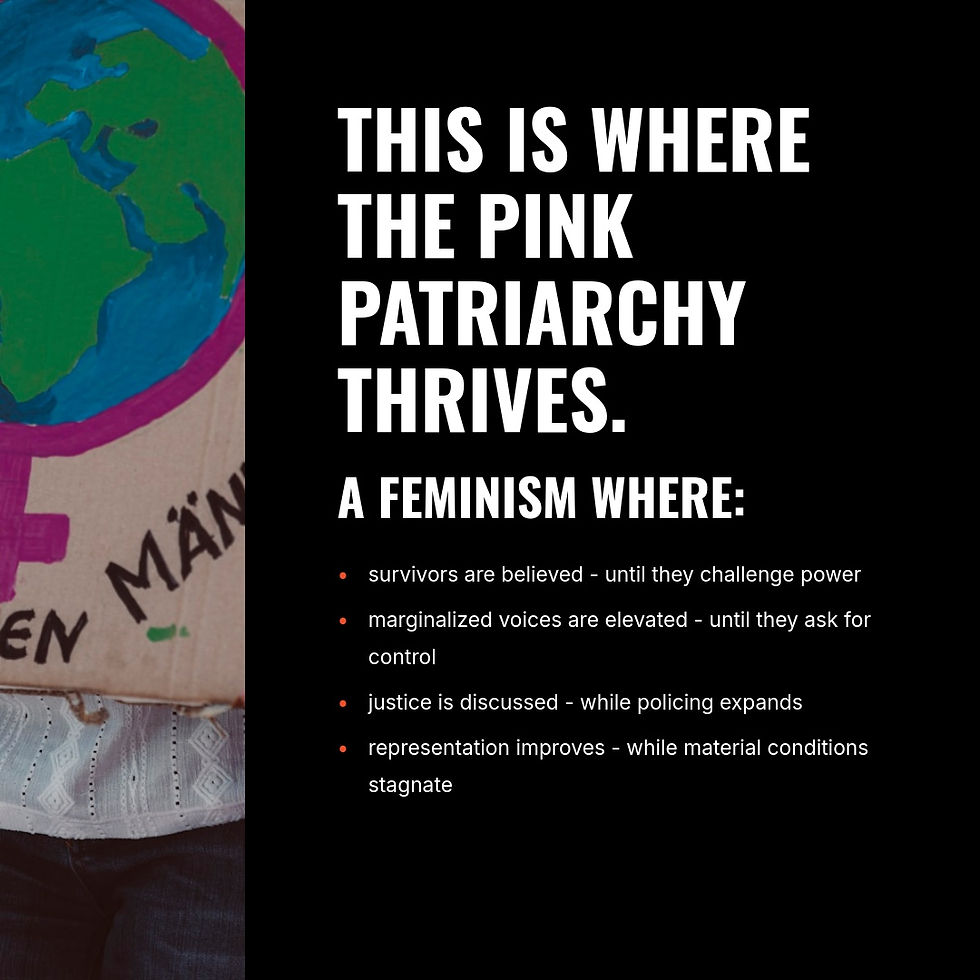
Fourth-wave feminism gave us the language to name harm - but it also gave institutions cover to rebrand control as care. The Pink Patriarchy thrives here: borrowing intersectional rhetoric, centering visibility, and maintaining hierarchy.
In this version of feminism:
Survivors are believed - until they challenge power
Marginalized voices are elevated - until they ask for control
Justice is discussed - while policing and punishment expand
Representation improves - while material conditions stagnate
Carceral responses are framed as protection. Surveillance is framed as safety. Accountability quietly becomes punishment.
Feminism sounds radical while doing very little to disrupt who holds the purse strings, the platforms, or the policies.
What Fourth-Wave Feminism Has - and Hasn’t - Solved
Fourth-wave feminism has undeniably shifted public consciousness. It has made it harder to deny sexual violence, transphobia, racialized harm, and economic exploitation. It has forced institutions to respond - at least rhetorically - to abuses they once ignored. It has expanded feminist analysis beyond individual success stories and into conversations about state power and systemic harm.
But it has not resolved the central contradiction it inherited: how to fight harm without reproducing control. Digital amplification has not eliminated hierarchy; it has often recreated it with better lighting. Intersectional language has not guaranteed intersectional outcomes.
And visibility has too often been mistaken for power.

The Fight Over the Future
Fourth-wave feminism sits at a crossroads. It has sharper tools, broader language, and more public attention than any wave before it. The question is whether it will use those tools to redistribute power - or simply to polish its image.
The wave framework, imperfect as it is, helps us see what’s at stake. Black feminists have always been intersectional. Indigenous feminisms follow different timelines altogether. Sex worker–led movements have long challenged the carceral instincts now resurfacing under feminist banners. Global feminisms often reject the wave model entirely.
The waves don’t tell the whole story. They tell us who had the microphone.
Fourth-wave feminism has named power.Now it has to decide whether it’s willing to give some of it up.
The future of feminism won’t be decided by hashtags, panels, or branding.It will be decided by who controls resources, policy, and safety - and who is still being sacrificed in the name of progress.
The language is there. The tools are there. The question is whether the courage is.

Fund liberation - not optics.
Your donation supports feminist work rooted in lived experience, accountability, and real-world impact - not polished talking points.


